Twilight lit up with colorful sparkles carpeting the ground around the silhouette of a nearby tree. Colors clustered together like starbursts, clumps of sapphire and aqua scattered around those of tangerine and ruby, alongside honey and violet drops. Where I stood at the limit of their glow, these small orbs twinkled up at me from the ground at my feet, illuminating dead and dying grass all around. I had not noticed in the dark.
Not too far away, the shadow of a person stood up from a crouch, holding an electric cord that led away into the lights. This they dropped on the ground with a faint thump. Rainbow light touched their legs but not their face, making them impossible to make out. I wondered if I looked the same to them.
“What’s this?” I asked.
Turning to me, the person’s bearing shifted to something like a smile. “A garden,” they said, looking over to view their work.
“Don’t you think flowers would be more useful?” I said. “Lights don’t make oxygen or cleanse carbon monoxide from the air.”
“True,” they said. Their voice dropped a key to sadness. “But it’s too late for conservation efforts in this place. Flowers no longer grow here.”
That sadness crept down my spine and lodged at the base. Remembering the deadened grass, I surveyed the area. By the fading sunlight, I noted lots of dwellings, plentiful sidewalks, few trees. Almost no patches of earth where grass could grow. I wondered what had poisoned this ground so that flowers could not bloom here anymore.
“Besides,” the stranger added, “you can’t see flowers at night. Not like this.” A hitch crept into their voice, as if they fought back tears. “So this is alright. Yeah, it’ll have to do.”

Thanks for reading!
Subscribe for new stories, sneak peeks, book reviews, and updates delivered to your inbox and social feeds.
Bring the Wanderer Home
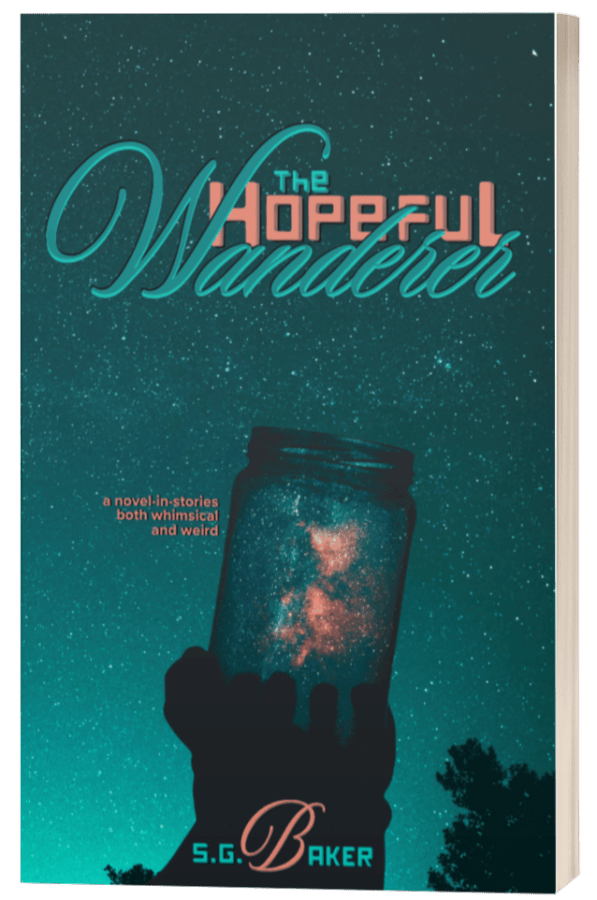
The Hopeful Wanderer
Wander a world driven from mundane to magical by a secret hidden at its heart.
A slow apocalypse has corroded a distant planet, with the uncanny living in uneasy commune alongside those remaining. On a forgotten quest from the stars, the Wanderer roams among them, through crumbling societies and vibrant wildernesses, navigating a murky path toward an incredible past.
While helping and receiving help-or hindrance-from strange denizens of unusual destinations, the Wanderer must finish righting a wrong that threatens to extinguish the universe itself. Should memory of the responsibility return at all.
Featuring
- 100 Hopeful Wanderer tales
- 20 new short stories
- 10-episode revelatory ending
- 100% revised and expanded
A far-future science fantasy with sub-tones of soft-apocalypse and climate change, this hopeful adventure combines exploration, eeriness, and wonder across 100 short tales.
Join readers who loved the web series and journey alongside them in discovering the Wanderer’s wondrous past and hopeful mission to save the stars.
Woven through with themes of acceptance, kindness, beauty in difference, and the wonder and strangeness of nature, this story will charm and delight readers of Mushishi by Yuki Urushibara and fans of The CryptoNaturalist and Strange Animals by Jarod K. Anderson.
“I love how varied the experiences were. The heartwarming stories mixed right in with the unsettling and strange is a perfect picture of life. The underlying story for why this is all happening was absolute perfection…Definitely one of the more unique story collections I have read. I really enjoyed it!”
—Amanda K. Collier, ARC Reader, The God of the Backrooms
“This is a whimsical yet potent selection of interwoven short stories about a Wanderer searching for something they once held dear. This book is filled with beauty, sadness, monsters, brilliant deadly things, and hope. You cannot forget the hope. This is a book for those that want to touch the stars.”
—Laci McGee, ARC Reader, McGee Travel Tales
“Every part of S.G. Baker’s collection The Hopeful Wanderer has purpose. Sometimes obvious, other times layered and more hidden…Every vignette deserves mental, cognitive, and emotional scrutiny. The fragmentation we experience shines a bright light — bringing visible things wondrous, frightening, and difficult to explain…This is the type of book that begs you to engage beyond the plot and rewards you with more questions.”
—Jason Brown, ARC Reader, Toastx2
Show Your Support
If you enjoy my writing, please consider leaving a tip. All amounts welcome!


